"Peace Prayer" - Bethlehem Olive Wood - Five-fold Cross Cantonnée - One of a Kind Handmade Chaplet
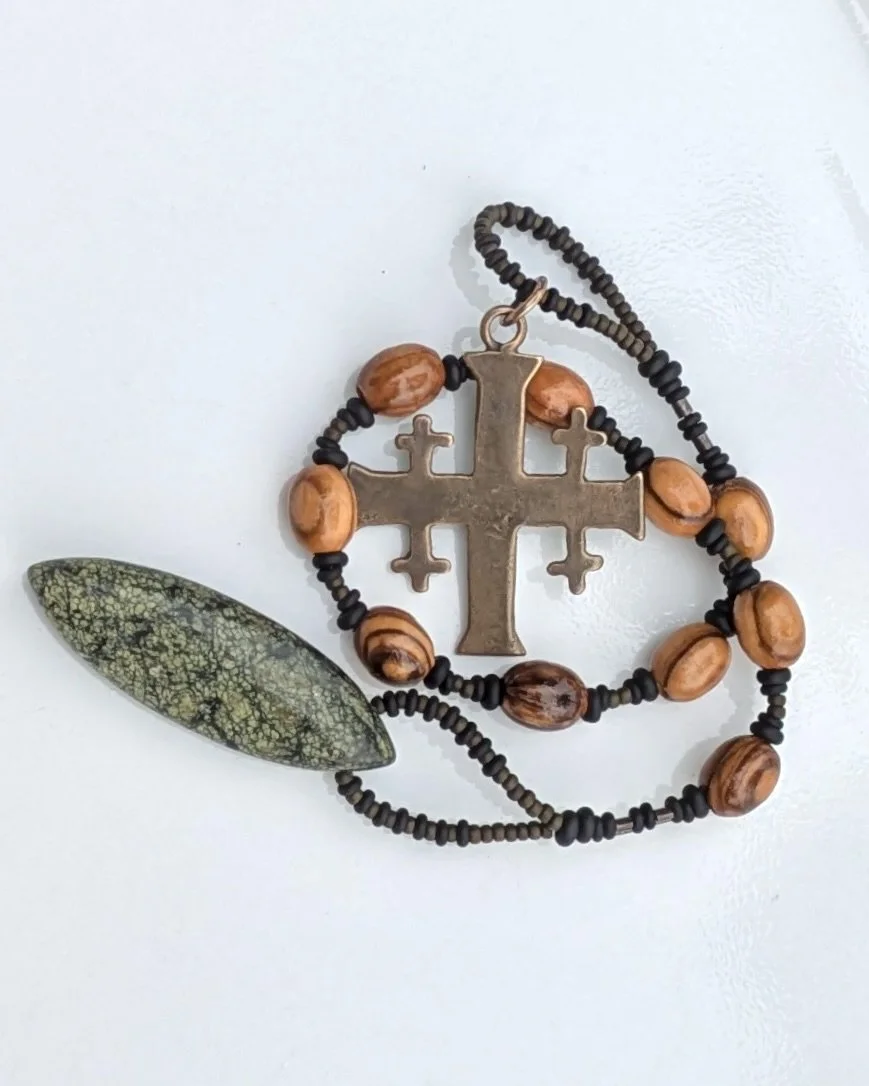
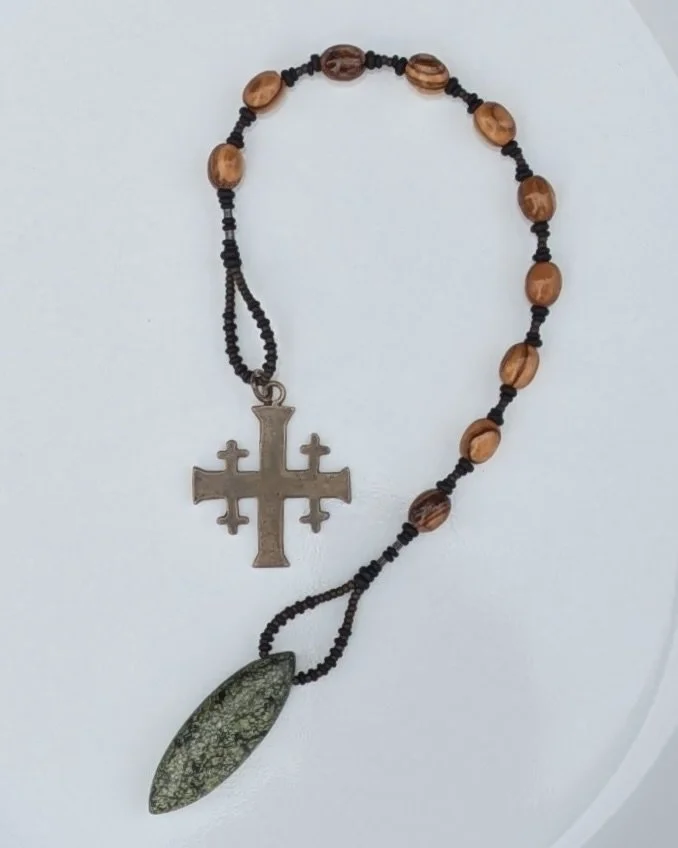
"Peace Prayer" - Bethlehem Olive Wood - Five-fold Cross Cantonnée - One of a Kind Handmade Chaplet
"May a constant prayer for peace rise in the Church with the praying of the rosary..."
— Saint John Paul II
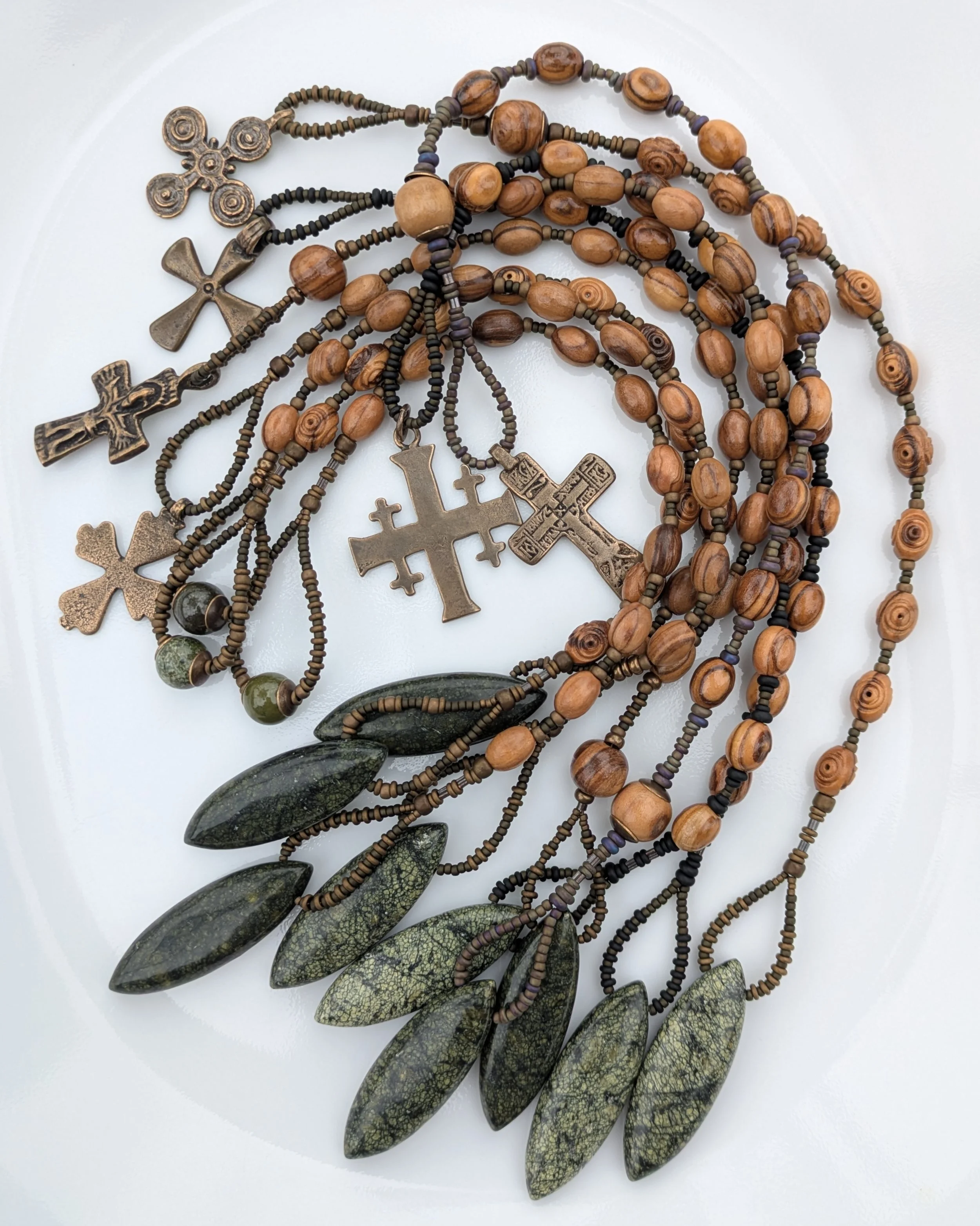
This one-of-a-kind chaplet is part of our series of Peace Chaplets made of olive wood beads carved in Bethlehem, Palestine — birthplace of Jesus, the Prince of Peace. The wood from which these beads are made comes from branches pruned from the local olive groves there — olive branches themselves are an age-old symbol of peace.
Each of the chaplets in this series also incorporates a green stone pendant reminiscent of an olive leaf.
The Five-fold Cross Cantonnée of this chaplet is solid bronze, cast from an antique original. (A cantonnée cross is “any large cross closely surrounded by four smaller ones of similar design.” — F. R. Weber, Church Symbolism, 1927.) For more about the varied symbolism of this cross, see below.
The olive leaf pendant is stone, in mottled greens. (We’re not positive which type of stone it is.)
The prayer beads are Bethlehem Olive Wood.
The spacer beads are matte glass in black and dark green, in various shapes and sizes.
The chaplet is strung on premium quality Soft Flex jewelers’ cable composed of 49 strands of steel encased in nylon, with a test strength of 26 pounds. Each end is double-crimped for security.
Crucifix: 1.5” - 39mm
Olive Leaf Pendant: 1.75” - 45mm
Aves: about .3” x .4” - 7mm x 9mm
Length: 13”
—
As with any symbol, what this style cross connotes varies according to the context and the beholder.
This cross has been widely understood to symbolize Christ and the Four Evangelists, the Five Wounds of Christ, Christ and all the corners of the world, The Holy Trinity — and more.
The Crusaders’ Cross, The Jerusalem Cross:
During the Crusades, this style cross was worn and carried as an emblem by the Crusaders, and some people nowadays wear or carry it to honor or emulate the Crusaders. In that context it’s generally known as the Crusaders’ Cross or as the Jerusalem Cross.
The Jerusalem Cross, The Franciscan Cross, The Pilgrims’ Cross:
When St. Francis of Assisi sent his friars out into the world, this style cross was the emblem of the friars he sent to Jerusalem, whose mission was (and still is) to guard and care for the Holy Places, to do charitable works, and to care for pilgrims. Still to this day, this cross remains the emblem of the Order of the Franciscan Friars Minor in Jerusalem. In those contexts, this cross is known as the Jerusalem Cross, the Franciscan Cross, and the Pilgrims’ Cross.
The cross of the Latin Patriarchate of Jerusalem:
Today this cross is the emblem of the Latin Patriarchate of Jerusalem — which is the Roman Catholic diocese whose territory includes not only Jerusalem but all of Israel, Palestine, Jordan and Cyprus. (We see this cross on the shield of the Patriarchate, and embroidered on the vestments of the Patriarch of Jerusalem, Cardinal Pierbattista Pizzabella.)
Pope Francis, addressing the Franciscan Friars of Jerusalem, described what this cross symbolizes in the context of spiritual formation:
“… Initial and ongoing, practical and spiritual formation: they are four guidelines that we can see represented in the sign of the Cross, which stands out clearly on your mantles and inspires your spirituality. With its horizontal arm, it reminds you of your commitment to ensure that your dedication to the crucified and risen Christ embraces your entire life, and in charity makes you close to every brother and sister; while its vertical arm, firmly planted on the ground and pointing to heaven, reminds you of the inalienable complementarity, in your journey, between a life of prayer and service to your brothers and sisters, attentive, qualified, and well rooted in the realities in which you operate, aimed at the total good of the person (cf. Eph 3:17-19; Saint Thomas Aquinas, Commentary on Saint Paul’s Epistle to the Ephesians, III, lect. 5). …”
— Pope Francis, 11/9/23, address, Consulta of the Equestrian Order of the Holy Sepulcher of Jerusalem